

Bohemian fashion has never been one timeless look. The history of bohemian fashion is a story of reinvention, shaped by artists, changing ideas of freedom and cultural influences that deserve more than a passing mention. Its familiar mix of flowing fabrics, layered accessories and artisanal details is only one chapter.
If the term feels broad, you’re not alone. Popular style summaries often blend distinct eras together, making it hard to see how Parisian bohemia became a modern fashion shorthand. They can also repeat romanticised stereotypes of Romani people tied to the word “bohemian,” or detach cultural elements from their origins and meaning.
This guide traces the major periods that shaped bohemian dress, from its roots in nineteenth-century Paris through later countercultural movements and today’s polished interpretations. You’ll see how each era reworked the look, what its defining details signalled and how cultural influences entered the conversation. The result is a clearer way to recognise boho-inspired style, understand its layered history and make thoughtful choices about personal expression today.
Key Takeaways
- Follow the history of bohemian fashion through distinct eras, rather than treating “boho” as one unchanged look.
- Learn how artistic nonconformity shaped the early bohemian image, and why later romanticised portrayals need context.
- Compare the 1960s counterculture with the more commercialised bohemian references of the 1970s.
- Consider the origins and significance of cultural references before incorporating them into personal style.
- Use a simple approach to modern boho: identify the historical reference, understand its context, then style it with intention.
What Does Bohemian Fashion Mean, and Where Did the Idea Begin?
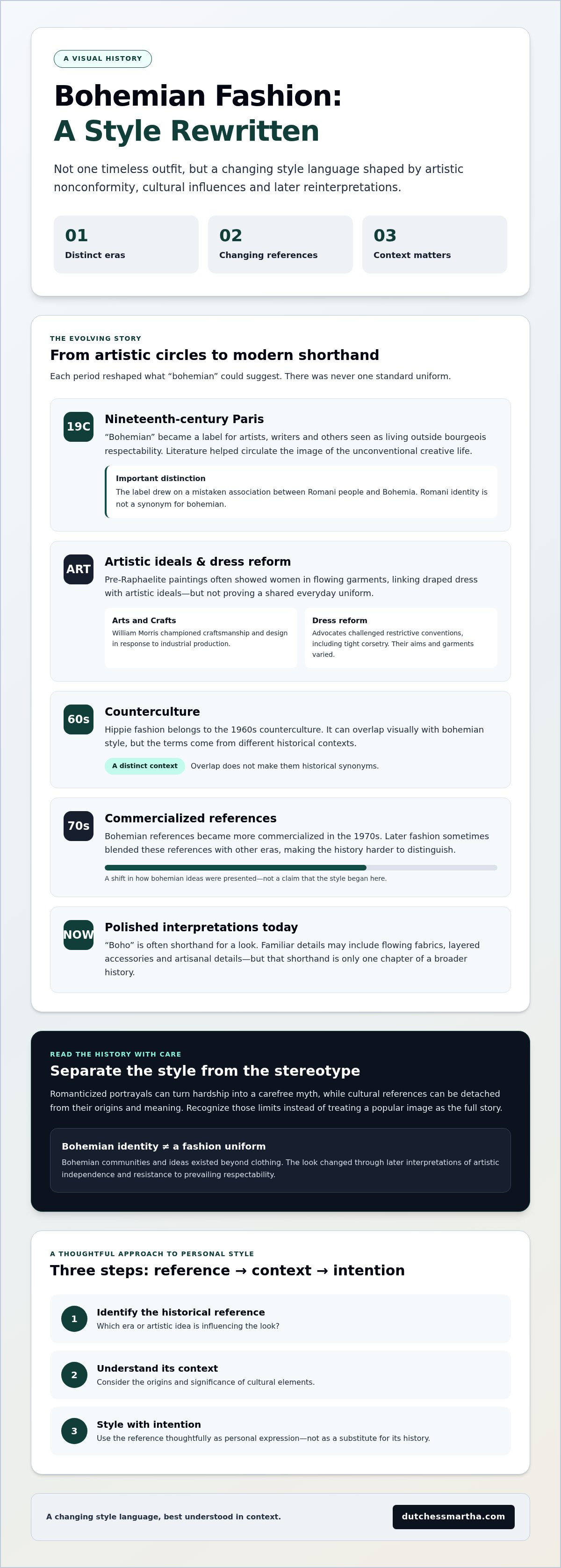
Bohemian fashion is a changing style language linked to artistic nonconformity, not a single outfit preserved across history. Its recognisable details have shifted as later generations borrowed and reworked ideas associated with creative independence. That distinction matters: bohemian identities and communities existed beyond fashion, while “boho” today is often shorthand for a particular look.
The term took hold in nineteenth-century Europe, especially in France, where “bohemian” was applied to artists, writers and others seen as living outside bourgeois respectability. The label drew on a mistaken association between Romani people and the region of Bohemia. Romani identity is not a synonym for bohemian, and romanticised uses of the label can obscure that history. The overview of Bohemianism explains the term’s origins and its connection to artistic circles in nineteenth-century France.
To understand the history of bohemian fashion, separate the original social image from the clothing styles later attached to it. There was no single, standard bohemian uniform. The look developed through changing interpretations of artistic independence, unconventional living and resistance to prevailing ideas of respectability.
Why Were Artists and Writers Called Bohemians?
In nineteenth-century Paris, “bohemian” became a label for creative people whose lives appeared to reject bourgeois conventions. Some artists and writers had limited means or unconventional routines, but popular stories often turned those circumstances into a romantic image of carefree independence. Paris helped circulate that archetype, but it wasn’t the sole source of unconventional artistic life or the only place where later bohemian styles took shape.
Literature helped make the figure familiar. Henri Murger’s stories about Parisian artists in Scènes de la vie de bohème, published in the 1840s, contributed to a popular image that later adaptations carried further. These portrayals show how bohemia was imagined, not what every artist wore or how every bohemian lived.
Is Bohemian Fashion the Same as Hippie Fashion?
No. Hippie fashion refers to styles associated with the 1960s counterculture, while bohemian fashion draws on a longer, repeatedly reinterpreted set of artistic and unconventional references. The looks can overlap in flowing silhouettes, layered accessories and a relaxed approach to formal dress, but the terms aren’t historical synonyms. Each belongs to a different context, even though later fashion has sometimes blended them together.
For a present-day view of wearable boho style, explore the guide to boho clothing and effortless chic style. It offers styling context without treating today’s fashion shorthand as a complete account of its past.
How Nineteenth-Century Artistic Movements Shaped Bohemian Dress
In the nineteenth century, clothing could signal more than taste. For some artists and reformers, rejecting conventional respectability also meant questioning rules about appearance: what was considered proper, refined or suitable for public life. Yet there was no shared bohemian uniform. The history of bohemian fashion is partly a history of ideas about dress, and partly a later story shaped by how artists and their lives were portrayed.
The Pre-Raphaelites, Arts and Crafts, and Dress Reform
The Pre-Raphaelite Brotherhood was an artistic movement, not a fashion label. Its painters looked to medieval and early Renaissance art, and often depicted women in long, flowing garments. Those images helped establish a visual association between artistic ideals and draped dress, but they don’t prove that artists or their models wore one consistent style in everyday life.
William Morris’s Arts and Crafts movement brought attention to the quality of design and making. Morris is known for creating decorative patterns and championing craftsmanship in response to industrial production. That emphasis connects the movement to later ideas of handmade beauty, but it shouldn’t be reduced to a clothing trend. Separately, dress reform advocates challenged restrictive conventions, including tight corsetry. Their aims and garments varied, so no single outfit represented all reformers or artistic groups. The history of Bohemian dress traces how Romanticism, the Pre-Raphaelites and Arts and Crafts contributed to the evolving image.
How Romantic Imagery Created a Bohemian Look
Paintings and writing offered compelling images of the unconventional artist, while reproductions helped those images travel beyond the circles where they began. Romantic art’s flowing robes and medieval references could suggest freedom from modern rules. Later accounts often gathered these visual cues into a neat “bohemian” look, even though the paintings were artistic interpretations rather than snapshots of everyday wardrobes.
That distinction helps keep the history clear. A long dress in a painting is evidence of an image the artist chose to create, not proof that all women in an artistic community dressed that way. Later fashion summaries can flatten differences between artistic movements, dress reform and ordinary nineteenth-century clothing, turning varied ideas into a single aesthetic. Ask whether a garment is documented as a practice, presented as an artistic ideal or added to the story by later retellings.
For a contemporary take on expressive dressing, explore modern boho-chic clothing as a personal style choice, distinct from the historical movements that helped inspire it.
How Bohemian Fashion Changed from the 1960s to the 1970s
Across these decades, clothing linked to personal freedom appeared in different settings. In the 1960s, some young people used dress to signal affiliation with countercultural and protest movements, including anti-war activism. In the 1970s, designers and fashion media increasingly reworked relaxed, romantic references for a wider market. The shift wasn’t a clean break: countercultural ideas persisted even as versions of the look became commercially available.
The 1960s Counterculture and Its Fashion Signals
There was no single counterculture wardrobe. Denim, handmade or customised garments, and less formal silhouettes could communicate distance from conservative expectations, but clothing choices varied by person, place and movement. A garment alone can’t confirm someone’s politics or beliefs. Museum collections also show that the decade’s fashion included mainstream design, such as Mary Quant’s youth-oriented styles, alongside countercultural dress. These strands overlapped, but they weren’t interchangeable.
The 1970s Boho Image Goes Mainstream
In the 1970s, fashion magazines, designers and ready-to-wear retailers helped make romantic, relaxed looks more visible beyond activist and alternative communities. Yves Saint Laurent’s 1976 collection inspired by Russian dress is one example of a designer bringing historical and folkloric references into high fashion. The Metropolitan Museum of Art’s Costume Institute collection provides a record of the designer’s work. This kind of reinterpretation wasn’t the same as wearing clothes as a direct countercultural statement.
A countercultural look enters the mainstream when designers and retailers recast its signals as fashionable choices for a wider audience. That process can broaden a style’s appeal while softening or detaching it from its original social context.
| Decade | Context | Silhouette and styling | Cultural associations |
|---|---|---|---|
| 1960s | Youth culture, protest and challenges to conventional norms | Varied, informal, individual and sometimes customised dress | Countercultural expression, though clothing didn’t define a person’s beliefs |
| 1970s | Fashion media, designers and ready-to-wear broadened access to romantic references | Relaxed and historically inspired looks appeared in commercial fashion | Bohemian imagery increasingly circulated as a style choice |
The comparison clarifies the history of bohemian fashion without reducing either decade to fringe, florals or loose shapes. Similar details could carry different meanings depending on who wore them, where they appeared and how they were presented. The 1970s didn’t simply copy the 1960s. They reshaped some of its visual language for new audiences.
Which Cultural Influences Shaped Bohemian Fashion, and What Needs Nuance?
Bohemian fashion has been reshaped across generations, drawing on artistic ideals, changing social movements and visual references from different cultures. That layered history shouldn’t turn any community’s clothing, symbols or traditions into a generic trend. A motif may look decorative to an outsider while holding specific meaning for the people and communities connected to it.
The word “bohemian” also needs care. It grew through romanticised stereotypes about Romani people, but Romani identity is not a fashion aesthetic or another name for boho style. The label’s history and the lives of Romani communities are distinct from the later fashion shorthand built around “bohemian” looks.
How to Discuss Cultural Influences Responsibly
Start with attribution. If a garment, motif or technique has a documented connection to a particular community, name that connection accurately rather than describing it as simply “ethnic” or “boho.” For contested or sensitive claims, consult museum collections, scholarly research and perspectives from the communities concerned.
Appreciation, exchange and appropriation aren’t interchangeable. Cultural exchange can happen through respectful, reciprocal contact. Questions of appropriation become more pressing when a meaningful design is removed from its context, presented without credit, or used by others while the originating community is misrepresented or excluded. No single rule settles every case, so consider the history, power dynamics and voices of people connected to the tradition.
For example, festival fashion has drawn criticism for presenting bindis or dupattas associated with South Asian cultures, and sacred Native American headpieces, as generic boho accessories. These examples aren’t interchangeable: each item has its own cultural context and significance. Naming that context is more thoughtful than grouping them under one trend label.
What Popular Boho History Often Leaves Out
Short style histories can flatten distinct eras into a timeless mood board. They may place artistic nonconformity, 1960s counterculture and contemporary festival dressing side by side as though each expressed the same ideas. They didn’t. Fashion details change meaning with their social and historical setting.
Marketing can also detach a visual reference from its origins. Once a design becomes a trend, its story may disappear behind broad descriptors such as “global,” “tribal” or “bohemian.” Treat those labels as prompts to ask questions, not reliable explanations. Separate what historical evidence establishes from modern interpretation, and avoid claiming a single culture created all bohemian fashion. The history of bohemian fashion is not one unbroken tradition; it’s a series of reinterpretations that deserve context.
Bring that thoughtfulness into your own wardrobe, and explore boho-inspired clothing as a way to express your personal style with intention.
What the History of Bohemian Fashion Means Today: From Historical Reference to Personal Style
Modern boho style doesn’t recreate one historical wardrobe. It selectively revisits ideas associated with earlier artistic and countercultural movements, then reshapes them for contemporary life. Flowing silhouettes, layered accessories, textured fabrics and handcrafted-looking details may suggest bohemian influences, but they’re modern styling signals, not proof that a look belongs to a particular historical era.
The history of bohemian fashion offers a useful way to make those choices with more intention. Try this simple framework:
- Identify the reference. Is it a silhouette, a period-inspired detail or a general mood?
- Understand its context. If a garment, motif or technique has a cultural origin, learn about it rather than treating it as decoration.
- Style with intention. Choose pieces that feel like you instead of copying a complete trend look.
How to Recognise a Modern Boho-Inspired Look
Today’s interpretations might pair a relaxed dress with considered accessories, or balance soft fabrics with structured pieces. There’s no definitive checklist. Think about proportion, texture and how each element works with the rest of your outfit. A layered look can feel expressive without being head-to-toe, and one distinctive accessory may be enough to add a personal touch.
For practical outfit ideas, explore the boho clothing style guide. Use it as inspiration, not a prescription. Let your own preferences lead.
Building a Personal Wardrobe with Historical Awareness
Start with what you already enjoy wearing. A dress, a relaxed top or a carefully chosen accessory can introduce a boho-inspired note without requiring a whole new wardrobe. As you choose, consider where a visual reference comes from and whether its meaning is being acknowledged. Historical awareness can make style more thoughtful while leaving plenty of room for creativity.
Clothing and accessories sold today shouldn’t be presented as historically authentic simply because they draw on familiar shapes or details. Modern interpretations belong to the present. They can still express individuality and reflect a considered interest in fashion history.
Shopping is optional. If you’d like to see one contemporary interpretation, explore Dutchess Martha’s curated fashion and lifestyle store, with women’s clothing and accessories in a modern, boho-chic style.
Carry Bohemian Style Forward with Intention
The history of bohemian fashion is a story of reinvention, not one enduring uniform. From artistic ideals to countercultural expression and modern style, each era reshaped what “bohemian” could mean. Recognising those shifts helps separate historical identities from today’s fashion shorthand.
It also makes room for more thoughtful style choices. Look beyond a familiar silhouette or detail: consider its context, acknowledge cultural origins where they’re known, and choose pieces that feel personal rather than relying on a head-to-toe trend.
For a contemporary expression of boho-chic, Dutchess Martha is an Australian fashion and lifestyle boutique in Bentleigh East, Victoria. Its curated range brings together modern boho-chic women’s clothing, including dresses, kaftans, tops and accessories, for a wardrobe that reflects your own point of view.
Explore Dutchess Martha’s curated fashion and lifestyle store to find contemporary pieces for your personal style.
Frequently Asked Questions
What is the origin of bohemian fashion?
The history of bohemian fashion begins with a nineteenth-century European label for artists and writers seen as living outside bourgeois conventions, especially in Paris. The label drew on romanticised, mistaken associations with Romani people, whose identity is distinct from bohemian style. Over time, artistic imagery and later fashion interpretations attached particular clothing ideas to the term. There was never one original outfit or uniform that defined every bohemian community.
When did bohemian fashion become popular?
Bohemian ideas have nineteenth-century roots, but the style became more visible to wider audiences through later fashion shifts. In the 1960s, some countercultural groups used dress to express distance from conventional norms. During the 1970s, designers, fashion media and commercial clothing helped popularise romantic, relaxed references beyond those communities. There isn’t one date when bohemian fashion suddenly became popular; its reach grew through successive reinterpretations.
What are the main characteristics of bohemian fashion?
Modern boho-inspired fashion often uses relaxed silhouettes, layered accessories, textured fabrics and decorative details. These are broad styling signals, not a fixed checklist or proof of historical authenticity. The look can be subtle, such as pairing a flowing dress with one distinctive accessory, or more layered and expressive. Consider the proportions and details you enjoy, and remember that cultural motifs may have meanings beyond their use as fashion decoration.
Did the Pre-Raphaelites influence bohemian fashion?
Yes, the Pre-Raphaelites influenced later images associated with bohemian dress, but they were an artistic movement, not a fashion label. Their paintings often showed women in long, flowing garments inspired by medieval and early Renaissance art. Those images helped connect artistic ideals with a particular visual style. They don’t establish that all artists, models or women of the period wore those clothes in everyday life.
How did bohemian fashion change in the 1970s?
In the 1970s, romantic and relaxed references became more visible in mainstream fashion. Designers, fashion media and ready-to-wear retailers helped take elements associated with earlier artistic and countercultural ideas to wider audiences. This wasn’t a complete break from the 1960s; styles and influences overlapped. But as bohemian imagery became a commercial fashion choice, it could become less directly connected to the original social or political context.
Is bohemian fashion culturally appropriative?
Not automatically, but some uses of cultural dress, motifs or symbols can be appropriative when they’re detached from their meaning, used without acknowledgement or presented as generic decoration. Consider the item’s origin, context and significance, and seek reliable sources or perspectives from the communities connected to it. Also distinguish Romani identity from bohemian style: the terms aren’t interchangeable, and romanticised stereotypes have shaped the word “bohemian.”